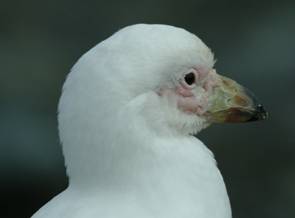
Snowy Sheathbill – Chionis alba
Other names: American Sheathbill; Yellow-billed Sheathbill; Greater Sheathbill; Sore-eyed Pigeons; Paddy; Hens with attitude; Mutts; Sh*t Chicken.
Spanish: Paloma Antarctica
German: Weissgesicht Scheidenschnabel
French: Grand Bec-en-Fourreau
Just two species of Sheathbill are in the Chionididae Family. Both species are geographically isolated. They belong to the Genus Chionis.
(The other Sheathbill is the Black-faced Sheathbill (Chionis minor), also known as Lesser Sheathbill are found in the sub-Antarctic Islands of the Indian Ocean. This species has totally black bill and leg colour, although variable, is different being black to pinkish-white. There are four sub-species of Black-faced Sheathbills recognised – differences being in the shape of the sheath and the colour of facial wattles and their legs.)
 |
 |
 |
During the breeding season Snowy Sheathbills can be found round the rocky shorelines of the Antarctic Peninsula, South Shetlands, South Orkneys and South Georgia. Non breeding birds and during the winter (of the Southern Hemisphere) birds are found in the south east of South America – Patagonia, Uruguay, the Falklands and occasionally as far north as Brazil. Ship assisted birds have made South Africa and Europe.
 |
 |
 |
Status: Not Globally Threatened
Population consists of approximately 10,000 pairs
Range: Sub-Antarctic Islands and the Antarctic Peninsula. Birds in south of range migrate to South America and the Falkland Islands to winter. Ship assisted vagrants have reached Europe.
Only species in Antarctica not to have webbed feet
 |
 |
Have an interesting little ‘mutt – mutt – mutt’ call
Birds regularly roost on one leg, often hopping around rather than using two legs.
Omnivorous – steals krill, fish, eggs and small chicks from breeding penguins – also eat carrion, faeces, algae and invertebrates – limpets are common
Breeding coincides with penguins and cormorants from whom they steal
Most fights are during the courtship period
Most conspicuous display is the ‘bowing ceremony’ used in, during and after pair formation.
Normally nests in a crevice or under a rock
Usually lay 2 – 3 eggs
Incubation is shared by both adults and takes between 28 and 32 days.
Fledging between 50 and 60 days.
Downy young are clearly recognisable
Absent from breeding sites from April to October


